By John R Savageau, President, Pacific-Tier Communications LLC
The race to build hyperscale and artificial intelligence (AI) data centers is creating an unprecedented challenge for electric utilities around the world. AI training clusters, cloud computing platforms, and high-performance computing (HPC) environments require enormous quantities of electricity, often exceeding the capacity of local grids and utility infrastructure.
In many regions, the question is no longer whether sufficient land, fiber connectivity, or cooling water can be secured. Instead, the fundamental constraint has become power.
As hyperscale operators search for solutions, a concept once considered improbable is rapidly moving into mainstream discussions: constructing small modular nuclear reactors (SMRs) or microreactors directly adjacent to data center campuses.
The idea raises important questions. Is nuclear energy a practical solution for hyperscale and AI infrastructure? What benefits could it provide? What risks and challenges remain? And will communities accept nuclear-powered data centers in their neighborhoods?
The Growing Power Problem
The modern hyperscale data center bears little resemblance to the enterprise facilities of a decade ago.
Traditional cloud environments might require tens of megawatts of power. Today’s AI training clusters can require hundreds of megawatts, and future AI campuses may exceed one gigawatt of continuous demand.
Many utilities simply cannot accommodate this growth.
Across the United States, Europe, and Asia-Pacific, data center developers are increasingly encountering:
- Utility interconnection delays measured in years
- Transmission congestion
- Limited generation reserves
- Escalating electricity costs
- Competition with residential and industrial consumers
- Carbon reduction requirements
In several major markets, grid connection has become the primary determinant of whether a data center project can proceed.
As a result, hyperscalers are exploring alternatives that provide dedicated, reliable, and scalable power independent of local utility limitations.
Why Nuclear Is Suddenly Back on the Table
For decades, nuclear power was considered too expensive, too slow, and too politically controversial for commercial technology companies.
Several factors have changed that equation.
First, AI workloads require continuous power. Unlike solar or wind generation, nuclear reactors provide 24-hour baseload electricity with capacity factors often exceeding 90 percent. Nuclear generation does not depend on weather conditions and can operate continuously for extended periods.
Second, many hyperscalers have aggressive carbon reduction commitments. Nuclear power offers low-carbon generation without the intermittency challenges associated with renewable energy.
Third, emerging SMR designs promise significantly smaller footprints and potentially shorter deployment timelines than traditional gigawatt-scale nuclear plants. Industry proponents argue that modular factory-built designs could reduce construction risk and allow capacity to be added incrementally as demand grows. Recent industry reporting indicates growing interest from major technology companies in securing future nuclear generation to support AI infrastructure.
Potential Benefits of On-Site Nuclear Generation
Reliable Power Supply
The most obvious advantage is energy security.
An on-site nuclear facility can provide continuous power regardless of utility constraints, reducing dependence on increasingly stressed transmission networks.
Scalability
Unlike diesel backup systems, nuclear generation can support both normal operations and future expansion.
A campus designed around modular reactors could potentially add generating capacity as additional AI clusters are deployed.
Reduced Carbon Emissions
For organizations pursuing net-zero or low-carbon strategies, nuclear power offers a pathway to large-scale clean energy without requiring vast renewable installations and associated energy storage systems.
Grid Support
An interesting possibility is that data centers could become net contributors to regional power systems.
During periods of lower computing demand, excess generation could potentially be exported to the local grid, helping utilities address peak demand or emergency conditions.
Improved Site Selection Flexibility
Historically, hyperscale facilities have clustered near areas with abundant utility capacity.
Dedicated nuclear generation could enable development in locations previously considered infeasible due to power constraints.
The Challenges Are Significant
Despite the potential advantages, numerous obstacles remain.
Regulatory Approval
Nuclear power is among the most heavily regulated industries in the world.
In many jurisdictions, reactor licensing can require years of review involving multiple national agencies, environmental authorities, emergency management organizations, and public consultations. Even if a data center operator is willing to invest in nuclear infrastructure, obtaining approval may prove far more difficult than constructing the facility itself.
Capital Costs
Although SMRs are often marketed as lower-cost alternatives to traditional nuclear plants, many designs remain unproven at commercial scale. Construction costs, financing requirements, security infrastructure, and regulatory compliance may significantly increase project expenses.
Technology Maturity
Many advanced reactor designs have yet to achieve widespread commercial deployment. While several projects are progressing, the industry remains in the early stages of implementation. Questions remain regarding construction schedules, operational economics, fuel supply chains, and long-term maintenance requirements.
Security Requirements
Any nuclear facility becomes critical infrastructure. Physical security, cybersecurity, insider-threat monitoring, emergency preparedness, and national security considerations would become integral parts of data center operations.
Waste Management
Even advanced reactor technologies must address spent fuel handling and long-term waste management. Although technical solutions exist, public concerns regarding radioactive waste remain significant.
The Public Opinion Challenge
Perhaps the greatest obstacle may not be technical or financial.
It may be social. Public perceptions of nuclear power continue to be shaped by historical accidents, concerns about radiation, and broader environmental debates. At the same time, communities are already expressing growing concerns about data center development itself.
Residents frequently raise questions regarding:
- Water consumption
- Electricity usage
- Land use impacts
- Environmental sustainability
- Visual impacts
- Noise
- Utility rate increases
Adding nuclear generation to the discussion may intensify public scrutiny rather than alleviate it. Recent commentary on data center expansion highlights the increasing importance of community acceptance, environmental stewardship, and transparent planning processes.
Opinion: Will Nuclear-Powered Data Centers Become Common?
In my opinion, the answer is yes, but not everywhere and not immediately.
It is unlilkely hyperscale facilities will eventually include an on-site reactor as a common feature, even when we begin to routinely pass 1Gigawatt of power load.
However, I do believe nuclear power will become an increasingly important component of the hyperscale ecosystem over the next two decades.
Several reasons support this conclusion:
- AI workloads are growing faster than utility infrastructure can expand.
- Grid interconnection timelines are becoming a critical business risk.
- Carbon reduction commitments are pushing operators toward clean firm power sources.
- Nuclear generation provides a unique combination of reliability, scalability, and low emissions that few alternatives can match.
- Data center consolidation and long term obsolescence will drive smaller data center decommissioning – with the possible exception of edge nodes supporting disaster recovery and IoT data collection.
That said, widespread deployment of reactor-powered data centers will depend on four critical factors:
- Regulatory modernization
- Demonstrated SMR commercial success
- Public acceptance
- Competitive economics
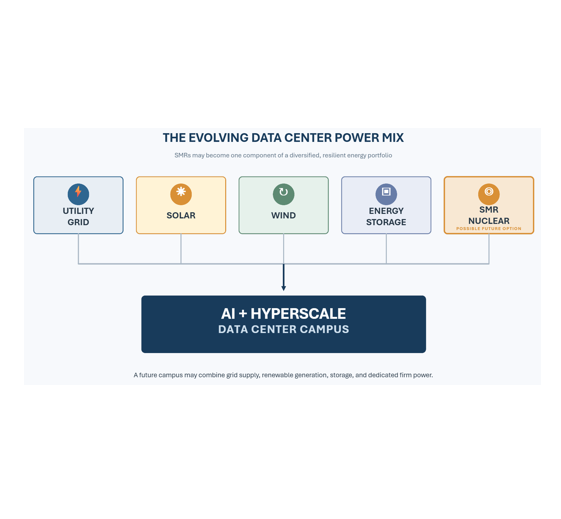
In the near term, the most likely model is not a reactor physically inside a data center campus, but rather dedicated nuclear generation located nearby and connected through long-term power purchase agreements.
As SMR technology matures and regulatory frameworks evolve, fully integrated nuclear-powered data center campuses may become increasingly common in regions where utilities cannot deliver the power required by next-generation AI infrastructure.
Conclusion
The future of AI may ultimately depend as much on energy infrastructure as on computing technology itself.
For decades, data centers were consumers of electricity. In the coming years, some may become power producers as well.
Whether through dedicated SMRs, advanced microreactors, or partnerships with existing nuclear facilities, the convergence of nuclear energy and hyperscale computing appears increasingly likely.
The real question is no longer whether nuclear power will play a role in supporting AI infrastructure.
The question is how quickly regulators, utilities, technology companies, and communities can work together to make it happen responsibly.
Leave a Reply