By: John R Savageau, President, Pacific-Tier Communications LLC
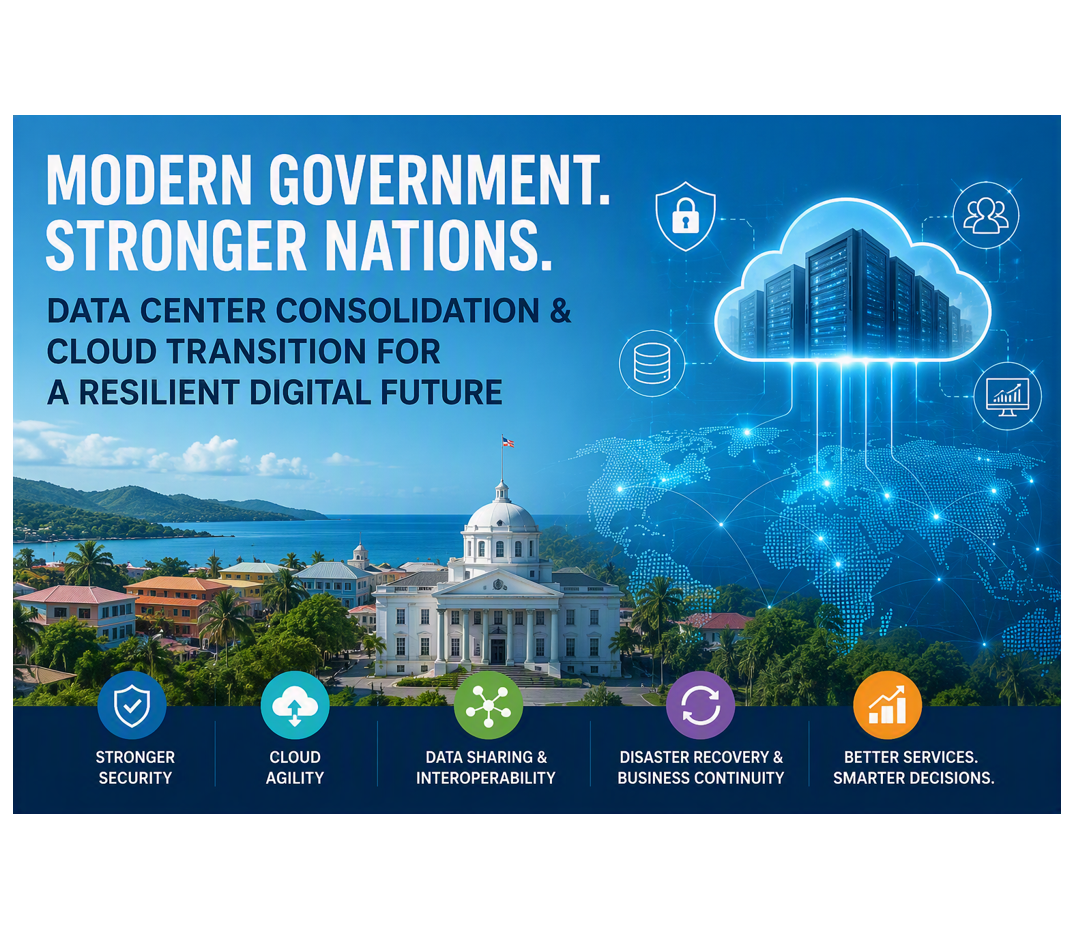
Modernizing Government ICT for Digital Transformation
Across the developing world, governments are facing increasing pressure to modernize aging ICT infrastructure while simultaneously improving citizen services, cybersecurity, interoperability, and operational resilience. For many small and developing nations, the challenge is compounded by limited budgets, shortages of specialized ICT personnel, fragmented technology investments, and the continued operation of ministry-owned server rooms that often lack adequate redundancy, security, and disaster recovery capabilities.
As governments seek to accelerate digital transformation, two strategic initiatives are emerging as foundational priorities:
- Data Center Consolidation
- Cloud Computing Adoption
While often discussed separately, these initiatives are increasingly being implemented together as part of broader Digital Government, Cloud First, and National ICT Modernization strategies.
The objective is not simply to replace aging servers. Rather, it is to create a modern digital ecosystem capable of supporting secure information sharing, data-driven decision-making, improved public service delivery, artificial intelligence, and resilient government operations.
Industry and development organizations increasingly emphasize that cloud and data infrastructure are essential enablers of digital government and economic development, particularly in low- and middle-income countries.
Why Governments Are Consolidating Data Centers
Historically, many government ministries, departments, and agencies (MDAs) developed their own ICT environments independently. Over time, this often resulted in:
- Hundreds of isolated applications
- Multiple incompatible databases
- Duplicated infrastructure investments
- Inconsistent cybersecurity practices
- Limited interoperability
- High operational costs
- Inadequate disaster recovery capabilities
The result is a fragmented ICT landscape that is difficult and expensive to manage.
Data center consolidation seeks to address these challenges by reducing the number of physical facilities and creating shared infrastructure environments capable of supporting multiple agencies. Similar themes appear in government modernization strategies and consolidation studies developed for developing-country environments.
Key Benefits
Reduced Costs
Consolidation reduces expenditures associated with:
- Power consumption
- Cooling systems
- Hardware maintenance
- Software licensing
- Facility operations
- Technical staffing
Instead of maintaining dozens of server rooms, governments can concentrate resources on a smaller number of professionally managed facilities.
Improved Cybersecurity
A centralized environment enables:
- Standardized security controls
- Centralized monitoring
- Security Operations Centers (SOCs)
- Consistent patch management
- Enhanced identity management
Better Disaster Recovery
Many government agencies still lack formal disaster recovery capabilities.
Consolidated infrastructure makes it easier to implement:
- Secondary recovery sites
- Automated backups
- Replication services
- Continuity of Operations (COOP) plans
Standardization
Consolidation encourages adoption of:
- Common operating platforms
- Shared services
- Enterprise architecture standards
- Government-wide security frameworks
These improvements ultimately reduce complexity and operational risk.
The Shift Toward Hybrid Cloud Models
While consolidation remains important, the most significant trend today is the movement toward hybrid cloud environments.
Rather than choosing between traditional data centers and cloud computing, governments increasingly adopt a combination of both.
A hybrid model typically includes:
- National Government Data Centers
- Commercial Cloud Providers
- Sovereign Cloud Services
- Disaster Recovery Facilities
- Shared Government Platforms
This approach allows governments to place workloads where they make the most sense.
For example:
Government Data Centers
Typically host:
- Sensitive national data
- Law enforcement systems
- Defense-related applications
- Critical government records
Public Cloud
Often hosts:
- Public websites
- Citizen service portals
- Collaboration platforms
- Development environments
- Data analytics services
Disaster Recovery Environments
May reside:
- In another region
- In another country
- Within a commercial cloud platform
This flexibility is particularly valuable for small island nations exposed to hurricanes, cyclones, volcanic activity, earthquakes, or other regional hazards.
Cloud Computing Is Becoming a Government Strategy, Not Just a Technology
Several years ago, cloud computing was primarily viewed as an infrastructure alternative.
Today, governments increasingly view cloud adoption as a strategic enabler of digital transformation.
Cloud platforms provide access to:
- Artificial Intelligence tools
- Advanced cybersecurity services
- Data analytics
- Geographic Information Systems (GIS)
- Digital identity platforms
- Collaboration tools
- Enterprise application hosting
For developing countries, cloud adoption can eliminate the need for substantial capital investments in physical infrastructure while providing access to technologies that would otherwise be unaffordable.
The World Bank has highlighted that many developing countries remain underserved by cloud and data infrastructure markets, making government leadership and policy reform important drivers of adoption.
Data Sharing and Interoperability Are Becoming National Priorities
One of the most overlooked benefits of consolidation and cloud migration is improved data sharing.
Many governments continue to operate in organizational silos where agencies collect the same information repeatedly because systems cannot communicate.
Modern cloud architectures support:
- API integration
- Shared data exchanges
- National data hubs
- Enterprise service buses
- Open standards
These capabilities enable governments to create “whole-of-government” digital services that improve both efficiency and citizen experience.
Examples include:
- Digital identity platforms
- National health systems
- Land management systems
- Tax administration systems
- Customs systems
- Social protection programs
The value of these systems increases dramatically when agencies can securely exchange information.
The Growing Importance of Disaster Recovery and Digital Resilience
Recent natural disasters and cyberattacks have highlighted a critical reality:
Many government systems remain vulnerable to single points of failure.
In small countries, a single hurricane, earthquake, or major cyber incident can disrupt government operations nationwide.
As a result, governments are increasingly incorporating resilience requirements into modernization initiatives.
Emerging best practices include:
- Active-active data center architectures
- Cloud-based backup platforms
- Cross-border recovery agreements
- Geographic redundancy
- Multi-cloud strategies
- Continuity of Government (COG) planning
For island nations, international disaster recovery partnerships may become a necessity rather than a luxury.
AI Is Accelerating the Need for Modern Infrastructure
Artificial Intelligence is rapidly becoming a driver of ICT modernization.
Governments are exploring AI applications for:
- Citizen services
- Fraud detection
- Public safety
- Healthcare
- Agriculture
- Education
- Economic planning
However, AI requires:
- Reliable data
- High-performance computing resources
- Secure storage
- Data governance
These requirements are difficult to achieve in fragmented legacy environments.
Data center consolidation and cloud computing provide the foundational infrastructure needed to support future AI initiatives.
Recommendations for Government Leaders
Governments considering modernization initiatives should focus on the following priorities:
1. Develop a National ICT Strategy
Ensure that data center consolidation, cloud computing, cybersecurity, digital identity, interoperability, and disaster recovery are integrated into a single strategic framework.
2. Establish a Cloud-First or Cloud-Smart Policy
Create clear guidance regarding when applications should remain on-premises and when they should move to cloud environments.
3. Conduct Application Rationalization
Identify:
- Duplicate applications
- Legacy systems
- High-risk infrastructure
- Modernization candidates
4. Create a National Data Governance Framework
Define standards for:
- Data ownership
- Data sharing
- Privacy
- Security
- Retention
5. Prioritize Disaster Recovery Early
Disaster recovery should not be an afterthought. Recovery requirements should be incorporated into modernization planning from the beginning.
6. Invest in Skills Development
Technology modernization is ultimately dependent upon people. Governments must invest in cloud, cybersecurity, enterprise architecture, and data management competencies.
Conclusion
The debate is no longer whether governments should modernize their ICT infrastructure. The question is how quickly they can transition from fragmented, aging systems toward resilient, interoperable, and cloud-enabled digital government platforms.
For many developing countries, the optimal solution is neither complete centralization nor complete outsourcing. Instead, the emerging trend is a carefully designed hybrid model that combines data center consolidation, cloud computing, cybersecurity modernization, and digital government transformation.
Governments that successfully implement these strategies will be better positioned to improve service delivery, strengthen resilience, support economic development, and prepare for the growing demands of AI-driven government operations.
Leave a Reply