By John R. Savageau, President, Pacific-Tier Communications LLC
The global race to build hyperscale and artificial intelligence (AI) data centers is accelerating at an unprecedented pace. Facilities that once consumed tens of megawatts are now being planned at scales exceeding 500 MW, with some proposals approaching or exceeding 1 gigawatt (GW) of power demand. To put this into perspective, a 1 GW data center campus may consume as much electricity as a large metropolitan area.
For states such as South Carolina, which offer attractive combinations of land availability, power infrastructure, connectivity, and business-friendly investment policies, the opportunities are significant. These facilities can bring billions of dollars in capital investment, expand local tax bases, stimulate utility modernization, and strengthen America’s leadership in cloud computing and artificial intelligence.
However, the scale of these developments raises an equally important question:
How can communities support digital infrastructure growth without sacrificing critical environmental resources, rural character, and ecologically sensitive landscapes?
The answer begins with responsible site selection.
The New Reality of Hyperscale Development
Historically, data centers were often located near major metropolitan areas where network connectivity and power infrastructure were readily available. Today’s AI facilities operate under different requirements.
Large language models, AI training clusters, and advanced cloud platforms require:
- Massive electrical capacity
- Large land parcels
- Access to transmission infrastructure
- Significant cooling resources
- Expansion potential for future growth
As traditional data center markets become constrained, developers increasingly look toward rural regions where land is less expensive and permitting may be less complex.
Unfortunately, some of these same areas contain:
- Wetlands
- Coastal ecosystems
- Wildlife corridors
- Agricultural lands
- Forest habitats
- Groundwater recharge zones
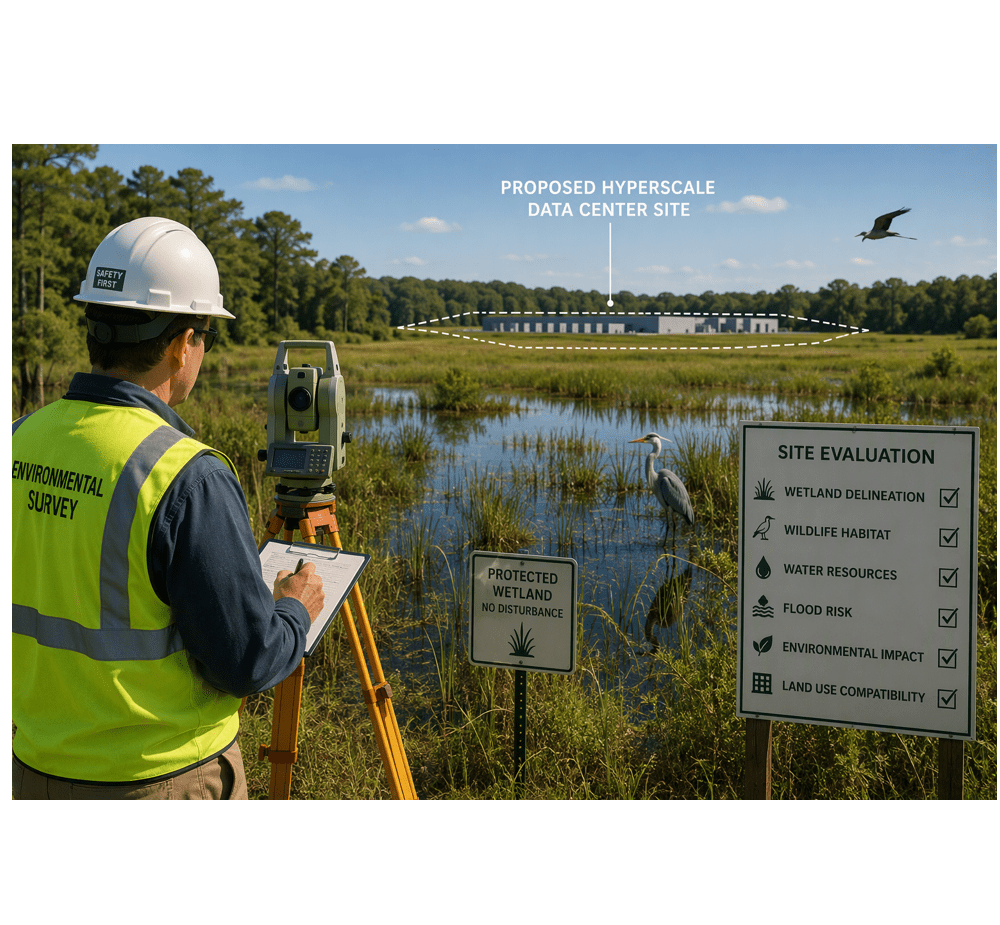
Without careful planning, the environmental consequences can be substantial.
Environmental Factors That Should Drive Site Selection
1. Avoidance of Critical Habitat Areas
The first principle should be straightforward:
Do not build large industrial facilities in ecologically sensitive areas when viable alternatives exist.
Environmental assessments should evaluate:
- Threatened and endangered species habitat
- Wetlands and marshes
- Migratory bird corridors
- Coastal ecosystems
- Protected forests
- Biodiversity hotspots
In states such as South Carolina, where wetlands, coastal forests, and wildlife refuges play essential ecological roles, the cumulative impact of large-scale industrial development can extend well beyond the project boundary.
Habitat fragmentation often has longer-term consequences than direct land clearing, disrupting breeding patterns, migration routes, and ecosystem resilience.
2. Water Availability and Sustainability
Water has become one of the most significant concerns associated with AI infrastructure.
Many modern data centers rely on evaporative cooling systems that can consume hundreds of millions of gallons of water annually. Public reporting has highlighted growing concern regarding water demand from data centers as South Carolina evaluates future AI-related growth.
Before approving large facilities, decision-makers should evaluate:
- Long-term groundwater sustainability
- Drought vulnerability
- Competing agricultural demand
- Municipal drinking water requirements
- River and watershed impacts
- Future climate projections
A region that appears water-rich today may experience significant stress during prolonged drought cycles.
Water-use efficiency (WUE) should become a core siting criterion rather than an afterthought.
3. Power Generation and Grid Impacts
Power availability remains the primary gating factor for hyperscale site selection. This is consistent with Pacific-Tier’s readiness assessment frameworks and procurement guidance.
However, environmental considerations extend beyond whether power is available.
Questions should include:
- What generation sources will support the facility?
- Will new fossil fuel generation be required?
- Can renewable generation meet a meaningful portion of demand?
- Will transmission corridors impact forests or wetlands?
- Will residential customers absorb infrastructure costs?
A 1 GW facility may require:
- New transmission infrastructure
- Additional substations
- New generation capacity
- Expanded reserve margins
The environmental footprint therefore extends well beyond the boundaries of the data center itself.
4. Land Use and Community Character
Rural communities often welcome economic development, but hyperscale facilities introduce industrial-scale infrastructure into landscapes that may have historically supported agriculture, forestry, tourism, or conservation.
Questions that local governments should ask include:
- Is the proposed land compatible with long-term regional plans?
- Are there existing industrial zones available?
- Will development create urban sprawl?
- How will visual impacts affect nearby communities?
- Are there cumulative impacts from multiple facilities?
A 1 GW campus can occupy hundreds or even thousands of acres when supporting infrastructure is included.
Smart growth policies should prioritize previously disturbed industrial land whenever possible.
5. Climate Resilience and Natural Hazard Exposure
Ironically, some of the locations attractive for development may also face increasing environmental risks.
Site selection should assess exposure to:
- Hurricanes
- Storm surge
- Flooding
- Sea level rise
- Wildfire
- Extreme heat
In coastal states such as South Carolina, resilience planning must consider infrastructure lifecycles extending 30 to 50 years into the future.
The cheapest site today may become the most expensive site tomorrow.
A Better Approach: Environmental Readiness Assessments
Governments should move beyond traditional permitting and adopt a more comprehensive environmental readiness model for hyperscale and AI developments.
This framework should evaluate:
Environmental Sustainability
- Habitat protection
- Water sustainability
- Carbon impacts
- Climate resilience
Infrastructure Readiness
- Power availability
- Transmission capacity
- Fiber connectivity
- Transportation access
Community Benefits
- Employment opportunities
- Workforce development
- Tax revenue
- Public infrastructure investment
Long-Term Stewardship
- Monitoring requirements
- Restoration commitments
- Transparency reporting
- Community engagement
Digital Progress and Environmental Responsibility Are Not Opposing Goals
Artificial intelligence will continue to drive demand for digital infrastructure. The question is not whether hyperscale and AI data centers will be built.
They will.
The real question is whether communities, regulators, utilities, and developers can work together to ensure that these facilities are located where they create the greatest economic value while causing the least environmental harm.
States such as South Carolina have an opportunity to become national leaders in responsible AI infrastructure development by demonstrating that economic growth, environmental stewardship, and community interests can coexist.
The most successful data center projects of the next decade will not simply be those with the most power.
They will be those that prove technological innovation and environmental responsibility can advance together.
About the Author
John R. Savageau is President of Pacific-Tier Communications LLC and advises governments, utilities, development organizations, and private-sector stakeholders on digital infrastructure strategy, data center readiness, cloud transformation, governance, and sustainable technology development worldwide.
 Pacific-Tier Communications LLC – ICT Solutions for Governments & Enterprises
Leave a comment