By Pacific-Tier Communications LLC
Every organization today depends on digital infrastructure. Whether supporting cloud services, financial transactions, healthcare systems, government operations, artificial intelligence platforms, or customer-facing applications, data centers and hosted information systems have become mission-critical assets.
As organizations accelerate digital transformation and invest heavily in cloud computing, hyperscale facilities, and AI-enabled services, one reality remains unchanged: risk cannot be eliminated.
The goal of risk management is not to create a risk-free environment. Instead, it is to identify uncertainties, understand potential impacts, make informed decisions, and build resilience against events that could disrupt operations, damage reputation, or affect financial performance.
For executives and investors, effective risk management should be viewed as a strategic business discipline rather than a technical compliance exercise.
Why Risk Management Matters
Modern organizations face an increasingly diverse set of risks.
Physical threats such as natural disasters, fires, flooding, utility failures, and civil disturbances can disrupt critical infrastructure. Cybersecurity threats continue to grow in sophistication and frequency. Supply chain dependencies, workforce shortages, regulatory changes, and geopolitical instability introduce new uncertainties that can affect both operational performance and long-term investment outcomes.
For organizations operating data centers or relying on hosted information systems, even a brief outage can result in:
- Lost revenue
- Reduced productivity
- Customer dissatisfaction
- Regulatory penalties
- Contractual liabilities
- Reputational damage
The consequences often extend well beyond the technical environment.
A Lifecycle Approach to Risk Management
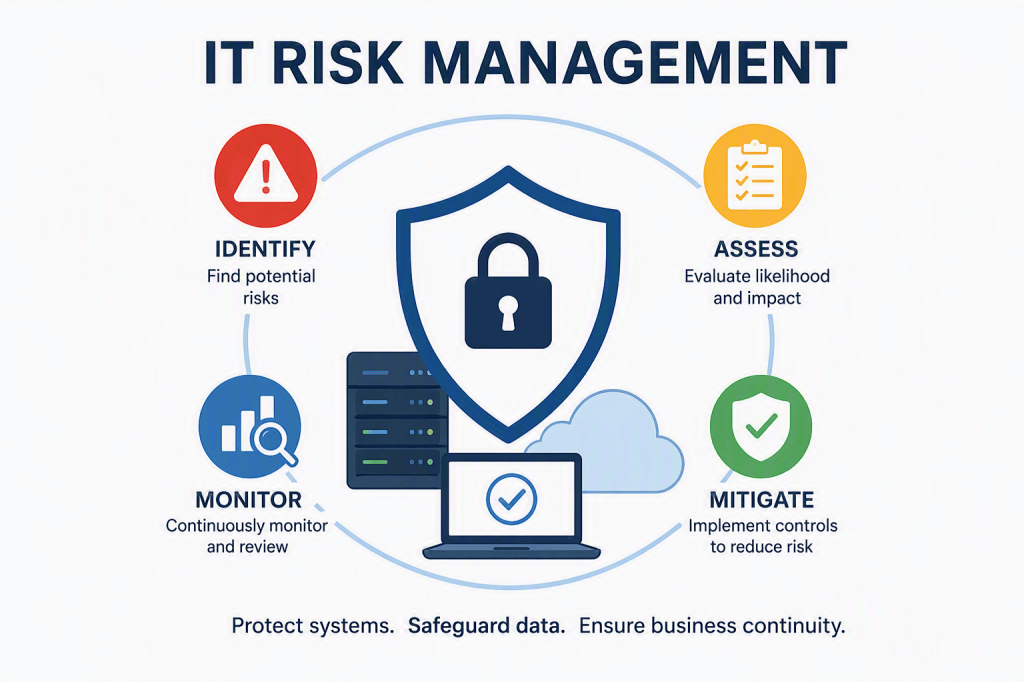
Although risk management frameworks can appear overly complex, most effective programs follow a straightforward lifecycle.
1. Understand What Needs Protection
The first step is identifying critical assets and business functions.
Organizations should understand:
- Which systems support mission-critical operations?
- Which data assets are most important?
- What infrastructure dependencies exist?
- Who depends on these services?
The objective is to establish a clear view of what is valuable and what would be affected if services became unavailable.
For example, an AI platform may depend on electrical power, network connectivity, cloud services, cooling systems, specialized GPU hardware, and highly skilled personnel. Understanding these dependencies creates the foundation for effective risk management.
2. Identify Potential Threats and Vulnerabilities
Once critical assets have been identified, organizations must consider what could go wrong. Threats can originate from many sources, including:
- Cyber-attacks
- Hardware failures
- Utility outages
- Extreme weather events
- Human error
- Third-party service disruptions
- Regulatory or compliance changes
At the same time, organizations should identify vulnerabilities that could increase the likelihood or impact of these events.
For example, reliance on a single network provider may represent a vulnerability. Similarly, inadequate backup power capacity or insufficient cybersecurity monitoring can increase organizational exposure.
3. Assess Likelihood and Impact
Not every risk deserves the same level of attention.
Effective programs evaluate two key dimensions:
Likelihood: How likely is the event to occur?
Impact: What would happen if it did?
This assessment helps leadership prioritize resources and focus attention on the risks that matter most.
For investors, this step is particularly important because it transforms abstract concerns into measurable business exposure, helping organizations allocate capital more effectively.
4. Develop and Implement Risk Treatments
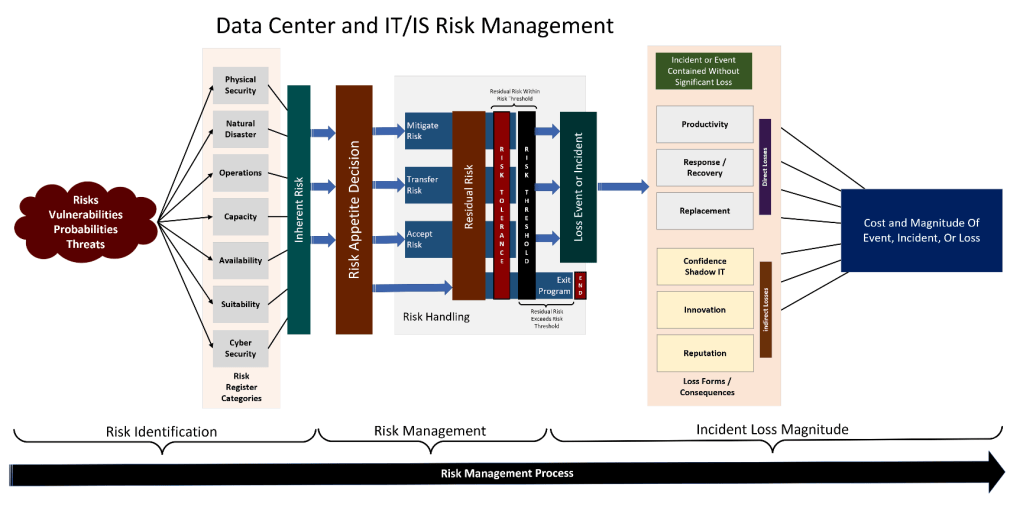
After identifying and prioritizing risks, organizations determine how they will respond. Generally, management strategies fall into four categories:
Avoid
Eliminate the activity creating the risk.
Mitigate
Implement controls that reduce likelihood or impact.
Transfer
Shift financial consequences through insurance, contracts, or outsourcing.
Accept
Acknowledge the remaining risk when mitigation costs exceed potential benefits.
Examples of mitigation measures may include:
- Redundant power systems
- Backup network connectivity
- Cybersecurity monitoring
- Business continuity planning
- Disaster recovery capabilities
- Workforce succession planning
- Vendor diversification
The appropriate mix of controls depends on business objectives and organizational risk tolerance.
5. Monitor, Review, and Adapt
Risk management is not a one-time project. Technologies change. Threats evolve. Business priorities shift. Organizations must continuously monitor their environments to determine whether existing controls remain effective.
Questions leadership should ask include:
- Have new risks emerged?
- Are mitigation measures functioning as intended?
- Have business priorities changed?
- Are investments aligned with current threats?
Continuous review helps organizations maintain resilience as operating environments evolve.
Understanding Residual Risk
One of the most important concepts for executives and investors is residual risk.
Even after implementing extensive safeguards, some level of risk always remains.
For example, a data center may feature redundant power systems, multiple telecommunications providers, advanced cybersecurity protections, and comprehensive disaster recovery plans.
Yet extreme events remain possible.
Residual risk represents the risk that remains after all practical mitigation measures have been implemented. The objective of executive leadership is not to eliminate residual risk. It is to understand, quantify, communicate, and consciously manage it.
This distinction is critical because organizations often spend disproportionate resources attempting to address risks that cannot realistically be eliminated.
Risk Management as a Business Enabler
Organizations sometimes view risk management as a compliance requirement or operational overhead.
The most successful organizations take a different approach.
Strong risk management programs:
- Protect critical revenue streams
- Increase investor confidence
- Improve operational resilience
- Support regulatory compliance
- Enable informed decision-making
- Strengthen stakeholder trust
- Reduce uncertainty during periods of change
In this sense, risk management becomes a strategic enabler rather than a cost center.
The Bottom Line
As reliance on digital infrastructure continues to grow, data center and information system resilience are becoming board-level concerns. The question is no longer whether disruptions will occur, but how prepared organizations will be when they do.
Organizations that understand their risks, implement appropriate controls, and continuously adapt to changing conditions are better positioned to protect operations, safeguard investments, and maintain stakeholder confidence.
Effective risk management is ultimately about making better decisions under uncertainty. In an increasingly digital world, that capability may be one of the most important competitive advantages an organization can possess.
 Pacific-Tier Communications LLC – ICT Solutions for Governments & Enterprises
Leave a comment