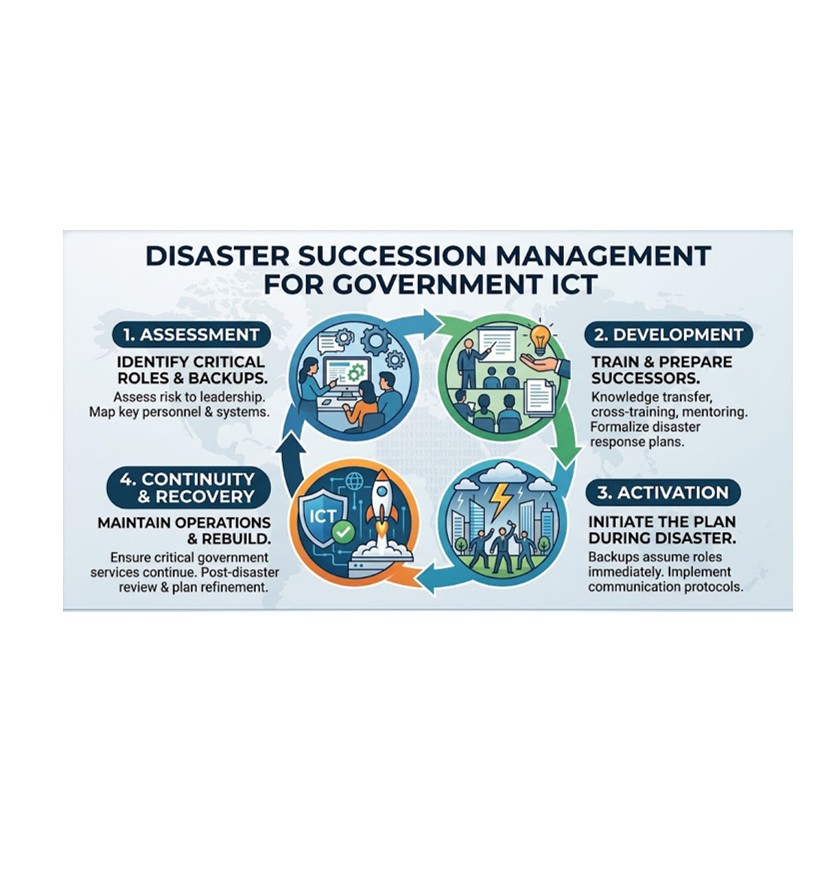
ICT Succession Planning: Building the Next Generation of Government Digital Leaders
By John Savageau, Pacific-Tier Communications LLC
Governments around the world are investing heavily in digital transformation, cybersecurity, cloud services, digital identity systems, data governance, artificial intelligence, and modern public service delivery. Yet many public sector organizations face a critical challenge that receives far less attention than technology itself: who will lead, operate, secure, and improve these systems in the future?
Technology modernization can be purchased. Leadership capability cannot.
As governments become increasingly dependent on digital platforms and information systems, effective ICT succession planning, leadership development, and career pathway management have become strategic priorities rather than human resource functions. Without deliberate planning, agencies risk losing institutional knowledge, experiencing leadership gaps, and struggling to retain the next generation of ICT professionals.
Research and government workforce guidance consistently emphasize that succession planning must be linked to competency development, continuous learning, and leadership preparation rather than simply identifying replacements for vacant positions.
Why ICT Succession Planning Matters
Government ICT organizations face unique workforce challenges.
Many agencies rely on a small number of highly experienced specialists who possess deep knowledge of critical systems, cybersecurity operations, enterprise architecture, telecommunications infrastructure, procurement processes, and regulatory requirements. When these individuals retire, resign, or move to other positions, decades of institutional knowledge can disappear overnight.
At the same time, governments compete with the private sector for skilled technology professionals. Private industry often offers higher compensation, faster advancement opportunities, and access to emerging technologies, making retention increasingly difficult. Structured career progression, professional development opportunities, and visible leadership pathways are therefore essential components of workforce sustainability.
Effective succession planning helps governments:
- Reduce operational risk
- Preserve institutional knowledge
- Improve workforce resilience
- Strengthen leadership continuity
- Increase employee engagement and retention
- Build internal capability for digital transformation
- Support long-term strategic objectives
Most importantly, succession planning ensures that government services continue uninterrupted even as personnel change over time.
Moving Beyond Replacement Planning
Many organizations mistakenly view succession planning as identifying a single replacement for a leadership position.
Modern succession planning takes a broader approach.
The objective is to build a sustainable pipeline of talent capable of assuming increasingly complex technical and leadership responsibilities. Rather than focusing solely on positions, governments should focus on developing capabilities and competencies throughout the workforce.
A mature succession planning program typically includes:
- Workforce and skills assessments
- Identification of critical positions
- Competency-based career pathways
- Leadership development programs
- Mentoring and coaching initiatives
- Cross-training opportunities
- Knowledge transfer mechanisms
- Continuous learning requirements
This approach creates organizational resilience while reducing dependence on individual employees.
Defining Leadership Competencies for ICT Professionals
Technical expertise alone does not create effective leaders.
Future government ICT leaders must combine technical knowledge with strategic, managerial, and interpersonal competencies.
As organizations progress through digital transformation, leadership requirements often expand beyond traditional technology management into areas such as:
Strategic Leadership
Future leaders must understand how technology supports national priorities, agency missions, and public service outcomes. They must be capable of aligning ICT investments with strategic objectives and communicating value to senior decision-makers.
Governance and Risk Management
Government ICT leaders are increasingly responsible for cybersecurity, privacy, compliance, resilience, and digital governance. They must understand risk management principles and ensure that technology investments support accountability and transparency.
Enterprise and Systems Thinking
Modern government services depend upon interconnected digital ecosystems. Leaders must understand how applications, infrastructure, data, security, and business processes interact across organizational boundaries.
People Leadership
The ability to recruit, mentor, motivate, and develop teams is often more important than technical expertise alone. Future leaders must be capable of building high-performing, multidisciplinary teams.
Change and Transformation Management
Digital transformation involves organizational and cultural change as much as technology implementation. Leaders must guide stakeholders through modernization initiatives while maintaining operational continuity.
Many governments are increasingly using internationally recognized competency frameworks such as SFIA and the NIST NICE Framework to define these skills and establish consistent workforce development pathways.
Creating Career Ladders for Government ICT Staff
One of the most effective retention strategies is providing employees with a clear understanding of how they can advance within the organization.
Career ladders provide transparency regarding:
- Expected competencies
- Required certifications
- Training requirements
- Experience expectations
- Leadership milestones
- Promotion opportunities
A typical government ICT career pathway may resemble:
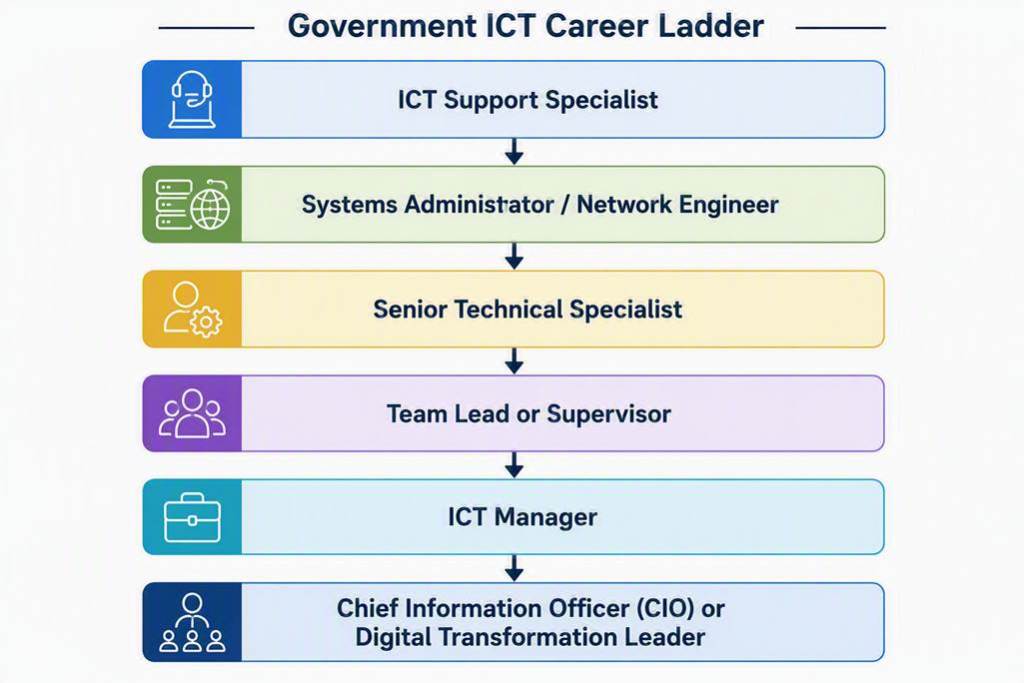
Importantly, not all employees aspire to management positions. Governments should also establish technical specialist career tracks that allow experts in cybersecurity, cloud architecture, enterprise architecture, data management, or telecommunications to advance professionally without moving into supervisory roles.
This dual-career approach helps retain highly skilled technical personnel while still developing future leaders.
The Role of Continuous Learning
Technology evolves faster than traditional government workforce planning cycles.
As a result, succession planning must be closely linked to continuous professional development. Governments should foster a culture in which learning is viewed as an ongoing responsibility rather than a one-time event. This includes formal training, certifications, mentoring, job rotations, communities of practice, and experiential learning opportunities.
Successful organizations invest in:
- Technical certification programs
- Leadership development courses
- Cybersecurity education
- Project and program management training
- Enterprise architecture education
- Data and AI literacy initiatives
- Mentoring and coaching programs
- Cross-agency assignments
Continuous learning not only improves capability but also enhances employee engagement and retention.
A Strategic Investment in Government Resilience
Digital transformation is ultimately a people challenge.
Governments that invest solely in technology risk creating sophisticated systems without the workforce needed to sustain them. Conversely, governments that invest in succession planning, competency development, leadership cultivation, and structured career pathways create a foundation for long-term success.
The most resilient public sector organizations recognize that tomorrow’s CIOs, cybersecurity directors, enterprise architects, and digital transformation leaders are already working somewhere within the organization today. The challenge is identifying, developing, and preparing them before critical vacancies occur.
ICT succession planning is therefore not merely a workforce management activity. It is a strategic investment in government capability, institutional resilience, and the future of public service delivery.
Key Takeaways
- Succession planning is about building capabilities, not just replacing positions.
- Government ICT organizations face significant risks from workforce turnover and retirement.
- Leadership development should combine technical, managerial, governance, and strategic competencies.
- Competency frameworks such as SFIA and NICE can support structured workforce development.
- Career ladders improve retention and provide visibility into advancement opportunities.
- Continuous learning is essential for maintaining digital government capabilities.
- Strong ICT succession planning strengthens government resilience and service continuity.
Sources: Government workforce succession planning guidance, public-sector digital skills development frameworks, SFIA, NIST NICE Workforce Framework, and Pacific-Tier experience supporting government digital transformation initiatives.
 Pacific-Tier Communications LLC – ICT Solutions for Governments & Enterprises
Leave a comment