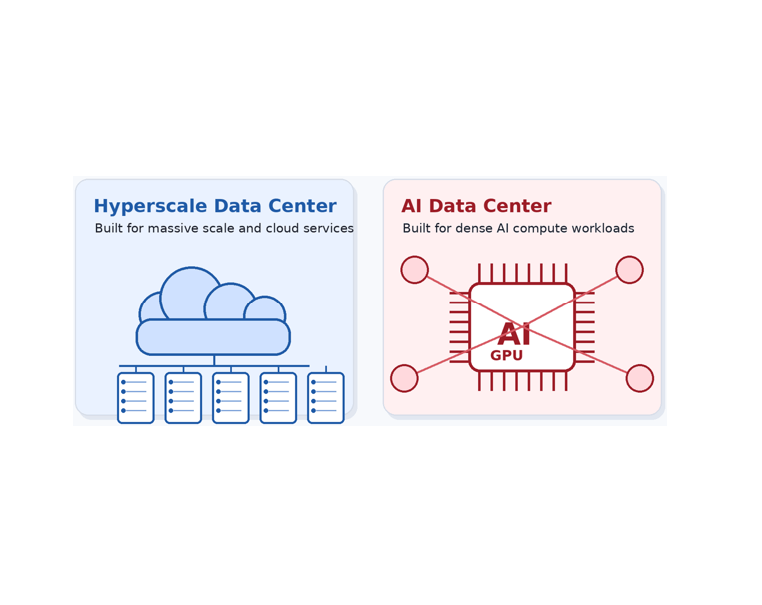
As governments, investors, and technology providers race to support the growth of artificial intelligence, the terms hyperscale data center and AI data center are often used interchangeably. While they share many characteristics, they are not the same thing.
Understanding the distinction is important for policymakers, utilities, regulators, and infrastructure planners because the requirements of AI workloads are beginning to reshape how data centers are designed, powered, cooled, and connected to the electrical grid.
What Is a Hyperscale Data Center?
A hyperscale data center is a very large-scale facility designed to provide massive computing, storage, and networking capacity that can expand rapidly as demand grows. Leading cloud providers such as Microsoft Azure, Amazon Web Services (AWS), and Google Cloud operate hyperscale facilities that support millions of users and thousands of enterprise customers worldwide. These facilities are characterized by large numbers of servers, highly standardized infrastructure, automation, and the ability to scale horizontally by adding more computing resources as needed.
In essence, hyperscale describes the size, scale, and operating model of the facility.
Typical workloads include:
- Cloud computing services
- Enterprise applications
- Data storage
- Streaming platforms
- Business analytics
- Software-as-a-Service (SaaS)
- Artificial intelligence workloads
What Is an AI Data Center?
An AI data center is designed specifically to support artificial intelligence and machine learning workloads. Unlike traditional cloud applications, AI training and inference require extremely high-performance computing resources, particularly Graphics Processing Units (GPUs), Tensor Processing Units (TPUs), and other specialized accelerators. These facilities emphasize dense compute configurations, very high-speed interconnects, advanced cooling systems, and significantly higher power densities than conventional data centers.
In essence, an AI data center is defined primarily by the nature of the workload rather than the overall size of the facility.
Typical workloads include:
- Large Language Model (LLM) training
- Generative AI services
- Computer vision
- AI-assisted scientific research
- Machine learning model development
- High-performance computing (HPC)
Where the Two Concepts Converge
Increasingly, many of the world’s largest AI deployments are being built inside hyperscale campuses. This has led to the emergence of what some industry observers call AI-ready hyperscale facilities or AI hyperscale data centers. These combine the scalability and operational efficiency of hyperscale infrastructure with the specialized hardware, networking, cooling, and power systems required for AI workloads.
However, not every hyperscale facility is optimized for AI, and not every AI data center operates at hyperscale.
A useful way to think about the distinction is:
| Characteristic | Hyperscale Data Center | AI Data Center |
| Primary Focus | Massive scale and cloud services | AI and machine learning workloads |
| Key Design Driver | Scalability | Computational intensity |
| Compute Hardware | Mostly CPU-based, some accelerators | GPU/TPU intensive |
| Network Requirements | High performance | Ultra-high bandwidth, low latency |
| Power Density | High | Very high |
| Cooling Requirements | Conventional and advanced cooling | Advanced liquid or hybrid cooling often required |
| Typical Size | Very large | Can range from moderate to hyperscale |
Why This Matters for Governments and Utilities
The distinction is more than technical terminology. AI facilities are changing infrastructure requirements throughout the digital economy.
Traditional enterprise data centers typically consume relatively predictable amounts of electricity. By contrast, AI deployments can create concentrated loads measured in tens or even hundreds of megawatts, similar to heavy industrial facilities. As a result, power generation, transmission, distribution, interconnection processes, and long-term grid planning are becoming critical factors in determining whether a country or region can attract AI investment. As noted in recent assessments of ASEAN markets, AI workloads introduce high-density, concentrated loads that may require substantial upgrades to generation and transmission infrastructure.
For policymakers, this means that attracting future digital infrastructure investment is no longer solely an ICT challenge. It is increasingly an integrated challenge involving energy policy, power system planning, environmental sustainability, workforce readiness, digital governance, and investment promotion.
Looking Ahead
The future is likely to see continued convergence between hyperscale and AI infrastructure. Many new facilities will be designed to support both traditional cloud services and increasingly demanding AI workloads. Countries that can provide reliable power, modern transmission infrastructure, transparent interconnection processes, cybersecurity protections, and effective digital governance will be best positioned to attract the next generation of data center investment.
For governments and infrastructure planners, the key question is no longer whether AI will drive demand for new digital infrastructure. The question is whether national policies, power systems, and regulatory frameworks are prepared to support it.
Pacific-Tier Communications LLC helps governments, utilities, regulators, and investors assess readiness for hyperscale and AI data center development, digital infrastructure modernization, power-sector planning, and technology governance in emerging and developing markets.
 Pacific-Tier Communications LLC
Leave a comment