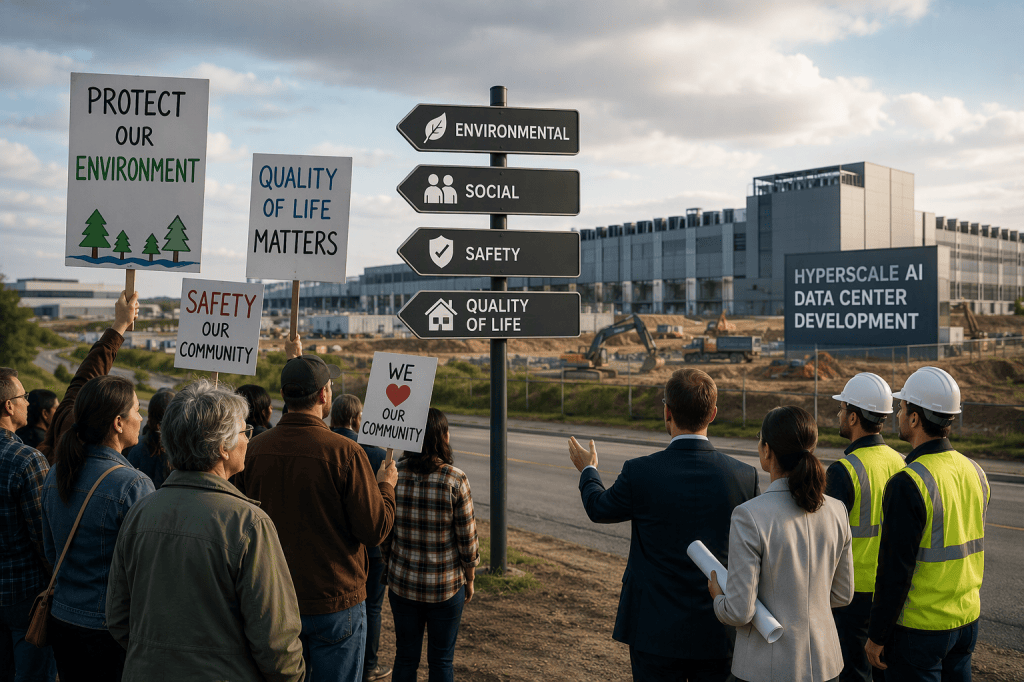
“The objective should not be to limit digital innovation, but to guide it. The next generation of AI and hyperscale infrastructure must be planned as part of an integrated energy, telecommunications, water, and sustainability strategy. The communities and nations that achieve this balance will be best positioned to capture the benefits of the digital economy while protecting the resources upon which future generations depend.”
Balancing Innovation, Sustainability, and Community Interests
Artificial intelligence, cloud computing, digital government, advanced telecommunications, and data-driven economies are rapidly increasing the world’s demand for computing infrastructure. Hyperscale and AI data centers have become the factories of the digital age, providing the computational power necessary to support everything from online commerce and healthcare to scientific research and national security.
Yet as demand accelerates, a growing conflict is emerging between the need for additional digital infrastructure and concerns regarding its environmental and social impacts.
The challenge facing policymakers, utilities, planners, investors, and technology companies is no longer whether more data centers are needed. The challenge is determining how to develop the next generation of digital infrastructure in a manner that is sustainable, socially responsible, and beneficial to the communities that host it.
The Growing Demand for AI and Hyperscale Infrastructure
The rise of artificial intelligence is fundamentally changing infrastructure requirements. Traditional enterprise data centers are increasingly being supplemented or replaced by large-scale hyperscale facilities capable of supporting cloud platforms, AI training clusters, high-performance computing, and advanced analytics.
Many new AI campuses require hundreds of megawatts of electrical capacity, with some future developments expected to approach gigawatt-scale power requirements. These facilities often require:
- Significant electrical generation and transmission capacity
- High-speed fiber connectivity
- Reliable water resources
- Large land parcels
- Advanced cooling systems
- Resilient transportation and logistics networks
As nations seek to participate in the digital economy, competition to attract these investments is intensifying. At the same time, the concentration of large-scale facilities in certain regions has raised legitimate questions regarding long-term sustainability and community impacts.
Industry observers, researchers, and environmental organizations have highlighted concerns related to electricity consumption, water use, land conversion, carbon emissions, and environmental justice associated with rapid AI infrastructure expansion. Recent research suggests that strategic siting, cleaner power systems, and improved operational efficiency can substantially reduce these impacts.
Understanding the Social and Environmental Concerns
The concerns surrounding large-scale data center development are not simply environmental. They often involve broader questions about community priorities and resource allocation.
Common concerns include:
Energy Demand
Large AI facilities can significantly increase regional electricity demand, potentially requiring new generation resources, transmission upgrades, and substation investments. In some markets, infrastructure expansion may struggle to keep pace with projected digital demand. Internal assessment frameworks developed for hyperscale readiness similarly identify generation adequacy, transmission capacity, and interconnection constraints as critical considerations.
Water Consumption
Many cooling technologies depend on substantial water resources. In water-stressed regions, local stakeholders increasingly question whether scarce water supplies should support industrial-scale computing operations. Research highlighted in environmental impact studies points to water use as one of the most significant sustainability challenges facing future AI infrastructure.
Land Use and Ecosystem Impacts
Large campuses can require hundreds of acres of land, sometimes affecting agricultural areas, wetlands, forests, or wildlife habitats. Poorly planned developments may create long-term environmental impacts that extend beyond the facility itself. In South Carolina where we are based there is a push to allow a very large data center to be developed in a area which supports very sensitive wetlands and habitats for resident and migrant wildligfe.
Community Impacts
Residents near some developments have expressed concerns regarding noise, visual impacts, increased traffic, and pressure on local infrastructure. In several jurisdictions, public opposition has become a significant factor in permitting decisions.
These concerns are real and deserve thoughtful consideration. However, they should not be viewed as arguments against digital infrastructure development. Rather, they highlight the need for better planning, better technology, and better policy.
Smarter Design and Siting Strategies
The future of sustainable digital infrastructure will depend heavily on where facilities are built and how they are designed.
Several promising approaches are emerging:
Prioritize Energy-Rich Locations
Future hyperscale and AI developments should be directed toward regions with:
- Surplus generation capacity
- Significant renewable energy potential
- Existing transmission infrastructure
- Strong grid reliability
Locating major facilities in energy-constrained regions may increase costs and delay both digital and energy transition objectives.
Align Data Centers with Renewable Energy Development
Co-development of renewable energy, battery storage, and digital infrastructure can reduce carbon emissions while improving grid flexibility.
Rather than being viewed solely as large consumers of electricity, future AI campuses could become anchor customers supporting new renewable generation projects.
Utilize Brownfield and Industrial Sites
Redevelopment of former industrial properties, retired power stations, logistics zones, and underutilized commercial land can reduce pressure on environmentally sensitive areas while accelerating permitting and infrastructure deployment.
Integrate Regional Planning
Data center planning should be integrated with:
- Energy planning
- Water resource management
- Telecommunications development
- Transportation planning
- Climate adaptation strategies
This integrated approach is increasingly reflected in digital infrastructure readiness frameworks and national planning initiatives.
Emerging Innovations That Could Change Everything
Technology itself may ultimately solve many of today’s challenges.
Several innovations show significant promise:
Advanced Cooling Technologies
Liquid cooling, immersion cooling, and closed-loop cooling systems can dramatically reduce water consumption while supporting increasingly powerful AI processors.
AI-Optimized Energy Management
Ironically, artificial intelligence may help reduce the energy demands of AI infrastructure itself through dynamic workload management, predictive maintenance, and intelligent cooling optimization.
Small Modular Reactors and Advanced Nuclear
While still emerging, advanced nuclear technologies may eventually provide reliable, low-carbon energy sources capable of supporting large-scale digital infrastructure.
Grid-Interactive Data Centers
Future facilities may function as active participants in energy markets by adjusting workloads during peak demand periods and supporting grid stability through battery storage and flexible operations.
Circular Resource Management
Future designs may emphasize:
- Water recycling
- Waste heat recovery
- Sustainable construction materials
- Equipment reuse and recycling
- Reduced embodied carbon
These innovations could significantly improve both environmental performance and long-term economics.
A Vision for the Future
The most successful digital infrastructure strategy is unlikely to be one that simply builds more data centers.
Instead, the future may involve integrated digital infrastructure ecosystems where:
- Data centers operate primarily on clean energy.
- Renewable generation, energy storage, and digital infrastructure are planned together.
- Waste heat supports nearby industries and communities.
- Water consumption is minimized through advanced cooling systems.
- Regional telecommunications networks, cloud infrastructure, and AI resources are interconnected and resilient.
- Communities share in the economic benefits of digital development.
- Environmental impacts are measured, disclosed, and continuously improved.
In this vision, data centers become more than computing facilities. They become strategic infrastructure assets supporting national competitiveness, scientific advancement, economic growth, and digital inclusion.
The objective should not be to slow innovation. The objective should be to guide innovation toward outcomes that are economically productive, environmentally responsible, and socially beneficial.
The future of AI and digital infrastructure will not be defined solely by processing power or computational scale. It will be defined by how effectively society balances technological progress with responsible stewardship of energy, water, land, and community resources.
That balance may ultimately become the most important innovation of all.
 Pacific-Tier Communications LLC – ICT Solutions for Governments & Enterprises
Leave a comment